How Far Should a Gas Grill Be From the House?
Keep a gas grill at least 10 ft from the house as a general rule, unless the grill manual or local fire code requires more. For how far a gas grill should be from the house, measure to the nearest wall or overhang and leave clear space above and around it.
On this page (9 sections)
- How far should a gas grill be from the house?
- Does the grill manual require more clearance?
- What should stay clear of a gas grill?
- Can you use a gas grill on a covered patio?
- How do you choose a safe grill location?
- What should you do before lighting the grill?
- Which gas grill fits a clear backyard setup?
- What common spacing mistakes should you avoid?
- How far should your gas grill be from the house?
For how far a gas grill should be from the house, use at least 10 ft as a general rule, unless the grill manual or local fire code calls for more. Set it outdoors on firm, level ground with space around and above it.
Measure from the grill to the nearest part of the home, including siding, doors, windows, and roof overhangs. A clear spot also needs room for people to move safely and for smoke to drift away from the house.
The 10 ft rule is a starting point, not a substitute for the instructions for your model or local requirements. Check those before you decide where the grill will live.
How far should a gas grill be from the house?
Start with at least 10 ft between the grill and the house. Measure to the nearest wall or overhang, then use a greater distance if the manual or local fire code requires it.
Keep combustible surfaces and materials away on every side. Heat rises toward eaves and awnings, while smoke can enter through open doors or windows, so check the full area around the grill.
Use the grill outdoors on a firm, level surface. A garage, enclosed porch, or other enclosed area is not a safe substitute for an open grilling spot.
Does the grill manual require more clearance?
Follow the model’s manual if it calls for more than 10 ft. Check its stated distances for combustible materials, overhead surfaces, and the back and sides of the grill.
If the manual is missing, look up the model’s instructions through the manufacturer before lighting it. Local fire codes and building rules can also set limits, so ask your local fire department or building authority if the requirements are unclear.
Measure the spot before you buy a grill or move one into place. Include room for the lid to open, access to controls, and a safe path around the cooking area.
What should stay clear of a gas grill?
Keep siding, fences, railings, dry leaves, cushions, furniture, and stored fuel away from the grill. Leave the space above it clear too, including eaves and other overhangs, unless the manual specifically allows that location and gives enough clearance.
A heat shield does not replace the distance required by the manual. If the only available spot puts the grill close to siding or an overhead surface, choose another location or check the rules before using it.
Avoid placing the grill where smoke will blow into the house or where it blocks an exit or walkway. Leave room for people to pass without brushing against the hot grill or its fuel connection.
How far should a gas grill be from vinyl siding?
Keep a gas grill at least 10 ft from the house as a general rule, including vinyl siding. Follow a greater distance if the manual or local rules require it.
Heat can warp or discolor siding, and nearby combustible materials can catch fire. Don’t treat a heat shield as a replacement for required clearance.
Can you use a gas grill on a covered patio?
Use a grill under a roof only when its manual permits that setup and the space meets its clearance and ventilation rules. An open-sided patio is not automatically safe just because it is outdoors.
Heat and smoke can collect near ceilings, beams, screens, and walls. Never use a gas grill in a garage, enclosed porch, or other enclosed area.
Renters and condo residents should check building rules before setting up a grill. Our guide to using a gas grill on a balcony covers the extra location checks for shared or restricted spaces.
How do you choose a safe grill location?
Choose a level outdoor spot that meets the required clearances and leaves a clear route around the grill. Keep it away from doors, regular foot traffic, and materials that could blow or fall onto the cooking area.
Before lighting, check that the grill is steady and that the hose and fuel connection are not pinched, stretched, or close to a hot surface. Keep the lid and controls accessible, and never move a hot grill.
For a small patio or a grill that needs to move between outdoor locations, portability can make setup easier. The Coleman RoadTrip 285 has quick-fold legs and wheels, and uses a 16.4 oz propane cylinder sold separately.
Its 285 sq. in cooking area and 3 adjustable burners suit portable outdoor cooking. Skip it if you need a fixed, full-size backyard grill or if you can’t keep it away from tents, vehicles, and other combustible surfaces.
A portable grill can be moved while cool, but wheels do not make it safe to cook closer to a wall. Pick the location first, then choose a grill that fits within the required space.
What should you do before lighting the grill?
Check the location, clear loose materials, and inspect the fuel connection before each use. Keep children and pets away, and stay near the grill while it is lit.
Open the lid before lighting unless the manual says otherwise. If you smell gas, don’t light the grill or operate electrical switches nearby; shut off the gas if you can do so safely, then follow the manual’s instructions.
Let the grill cool completely before moving or storing it. For planning fuel needs, see how long a propane tank lasts on a grill.
Which gas grill fits a clear backyard setup?
Choose a grill that fits your cooking needs and leaves its full required clearance in the space you have. A larger cooking area is useful only if the grill can sit safely with room around it.
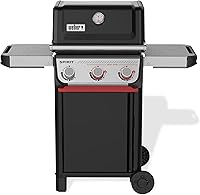
The Weber Spirit E-325 has 3 burners and 360 sq. in of cooking area, with a sear zone and fold-down side tables. It suits a backyard cook who wants a permanent grill and extra space for searing; skip it if its footprint would crowd the patio or reduce required clearance.
The Char-Broil Performance 4-Burner offers 435 sq. in of primary cooking space, a warming rack, and a side burner. It suits cooks who prepare several parts of a meal outdoors; skip it if you don’t need the added cooking area or can’t fit the grill with its required clearance.
Measure the grill’s footprint and the route to its intended spot before choosing either full-size model. For more about fuel and setup, read how to choose a propane grill.
What common spacing mistakes should you avoid?
Don’t measure only to the wall behind the grill. Check the nearest overhang, side wall, fence, and other combustible material, then follow the most demanding clearance rule that applies.
Don’t assume a roof, awning, or heat shield makes a close location safe. The manual and local rules determine whether that setup is allowed.
Don’t choose a spot before checking the grill’s full footprint and how people will move around it. A grill can technically fit while still blocking a door, narrowing a walkway, or sitting too close to something overhead.
How far should your gas grill be from the house?
Keep it at least 10 ft from the house as a general rule, then follow any greater distance in the manual or local fire code. Measure to the nearest wall or overhang, and leave open space around and above the grill.
Choose the Coleman RoadTrip 285 if portability matters and you have a clear outdoor spot. Choose the Weber Spirit E-325 or Char-Broil Performance 4-Burner for a permanent backyard setup only if the grill and its required clearance fit; for shared outdoor spaces, check balcony grill rules first.
Frequently asked questions
How far should a gas grill be from the house?
Keep the grill at least 10 ft from the house as a general safety rule, and follow the manual if it requires more clearance. Measure to the nearest wall or overhang, and keep the sides and space above the grill clear.
Local fire codes may also set requirements.
Can I grill under a covered patio?
Only if the grill manual allows that setup and the space has the required clearances and ventilation. Heat and smoke can collect under a roof, and nearby ceilings, screens, and walls may be combustible.
Never use a gas grill indoors, in a garage, or in an enclosed space.
Can a gas grill sit next to vinyl siding?
No. Keep the grill at least 10 ft from the house as a general rule, and follow any larger clearance in the manual.
Heat can damage siding, and flames can ignite nearby materials.
Check the area above and around the grill, not just the wall behind it.
Can I use a gas grill on a balcony?
Check building rules, local fire codes, and the grill manual before using one on a balcony. Some buildings prohibit grills, and a balcony can place a grill close to walls, ceilings, or railings.
See our guide to using a gas grill on a balcony for the key checks.